Skip to content

ADVODID Project

  • ADVODID Home
  • News
  • Publications
  • The ADVODID Team
  • ADVODID Events
  • Contact

News

January 13, 2026 / Uncategorized

Daniel Cruz passes his PhD viva

The ADVODID team are pleased to announce that last November, Daniel Cruz successfully passed his PhD defence at the University of Copenhagen. His dissertation examines how political elites make decisions under conditions of uncertainty, limited information, and institutional constraints, shedding new light on the cognitive and emotional foundations of elite behavior in contemporary democracies. Drawing on experimental and comparative evidence from Latin America, Europe, and the United States, the dissertation shows that politicians rely on heuristics, emotional reactions, and informational shortcuts when evaluating policies and political outcomes. His work demonstrates how electoral outcomes, policy diffusion, anecdotal information, and credibility cues shape elite attitudes and judgments, with important implications for democratic representation and accountability.

January 12, 2026 / Uncategorized

ADVODID and CBS Money in Politics Workshop

On the 27th November ADVODID and the Money in Poltics group based at the Copenhagen Buisness School held a joint workshop to present reserach on Political (Interest) Representation and Social Media. Presentations were given by the ADVODID team and Christian Grose (University of Southern California), Mikael Persson (University of Gothenburg), Rosanne Logeart (Copenhagen Business School), Fernando Mello (Universidad Carlos III de Madrid), Marie Seestedt (Copenhagen Business School) and Felix Hartmann (Copenhagen Business School). The workshop provided a great opportunity for all involved to share their emerging research on a topic that is developing at an increasing pace.

April 14, 2025 / Uncategorized

Tom Barton Interviewed in The Standard

In a recent article published in The Standard Tom Barton discussed his recent Political Science and Reserach Methods paper on the Voter ID pilot scheme in the UK, which showed a 4.4% point drop in turnout due to the specific scheme implemented. In the article Tom pointed out how the recent changes to the law in the UK could have negative implications for turnout and representation. This generated a response from the Government, who said “we are committed to strengthening the security of our democracy and making sure every legitimate voter can exercise their democratic right to vote. As set out in the manifesto, we are looking at improving voter registration and addressing the inconsistencies in voter ID rules that prevent legitimate voters from voting.”

January 27, 2025 / Uncategorized

Lise Rødland passes her PhD viva

The ADVODID team are pleased to announce that last Thursday (23rd January) Lise Rødland passed her PhD viva at the University of Oslo. Her thesis is titled: ‘Interest Groups and Political Representation in Long established European Democracies’ sheds new light on the role of interest groups as vehicles of political representation in long-established European democracies. It shows that interest groups tend to adopt positions that align with the preferences of citizens who are well represented through the electoral channel. However, the negative consequences of this, in terms of political representation, could be ameliorated because when a policy area is important to a party, the party tends to grant access to and be receptive to a wider range of interest groups.

January 27, 2025 / Uncategorized

Upcoming ECPR General Conference

In August the team will be presenting reserach from the the project at the ECPR general conference in Thessaloniki. This will include presentations on interest groups and social media, off and online interest group stratergies and how AI is used in lobbying.

August 5, 2022 / Uncategorized

Civil Society Engagement and Policy

In a new study in Comparative Political Studies Anne Rasmussen and Stefanie Reher study whether civil society engagement enhances the link between public opinion and policy. In other words: does joining (politically active) voluntary associations make it more likely that policy is in line with the preferences of the public? To answer this question, they analyse …

Continue Reading
August 5, 2022 / Uncategorized

GovLis Symposium: Lobbying for better or for worse?

The GovLis team is hosting a symposium that will bring together scholars interested in studying whether interest groups help or hurt the representation of the public. The event will take place at Leiden Unviersity (Campus The Hague) on April 25-26 and the deadline for proposing an abstract is March 1st. We hope to welcome you to the event! Please find more information on our event page.

August 5, 2022 / Uncategorized

ECPR General Conference

Together with Marcel Hanegraaff, GovLis project member Wiebke Junk is organizing a section on interest groups at the ECPR General Conference September. The event will take place in Wroclaw, Poland. The section is called: “Interest Group and Lobbying Research in an Integrative Perspective: Building Bridges Across the Discipline”Moreover, GovLis’ prinicpal investigator Anne Rasmussen chairs a …

Continue Reading
August 5, 2022 / Uncategorized

Framing and lobbying success: Why it pays to work as a team

Based on their research about the framing of policy issues, Wiebke Junk and Anne Rasmussen published a post at the London School of Economics’ EUROPP blog. In it they argue that if lobbyists or other interest groups want to use framing to affect policy outcomes, they should work together. In other words: if a single lobbyist tries to frame an issue a certain way, it’s unlikely to help him/her. However, if a larger number of actors frame an issue in the same way, it does help. Curious? You can click the link below to read the entire post.

Framing and lobbying success: Why it pays to work as a team


August 5, 2022 / Uncategorized

Gender equality and policy congruence

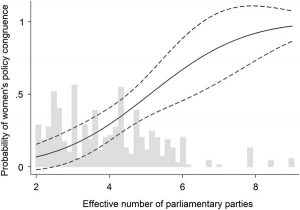
Does public policy in Europe reflect women’s preferences equally well as men’s? In this new study in the European Political Science Review, Stefanie Reher compares the opinions of women and men on 20 policy issues in over 30 European countries. She finds that in most cases, majorities of men and women want the same policy outcomes. However, when women and men do prefer different policies, men are more likely to get the policies they want. In the paper, Stefanie Reher also looks at differences across countries. She finds that the percentage of women in parliament is not related to the extent to which women get the policies they prefer. However, she does show that the higher the number of parties in parliament, the more likely that women’s preferences are reflected in policy (see figure below).


Posts navigation

  • 1
  • 2
  • Next

Featured study

This new paper by Anne Rasmussen, Simon Otjes in the Journal of Politics studies the magnitude and potential drivers of misperceptions by comparing actual public opinion on policy with estimations of public opinion by representatives at all government levels in Denmark and the Netherlands. Our results show misperceptions are widespread and associated with a tendency for representatives to project their own opinion onto the public. It is one of the largest studies on perceptions of public opinion to date, based on approximately 10,000 estimations by politicians.

© 2026 ADVODID Project - Powered by SimplyNews